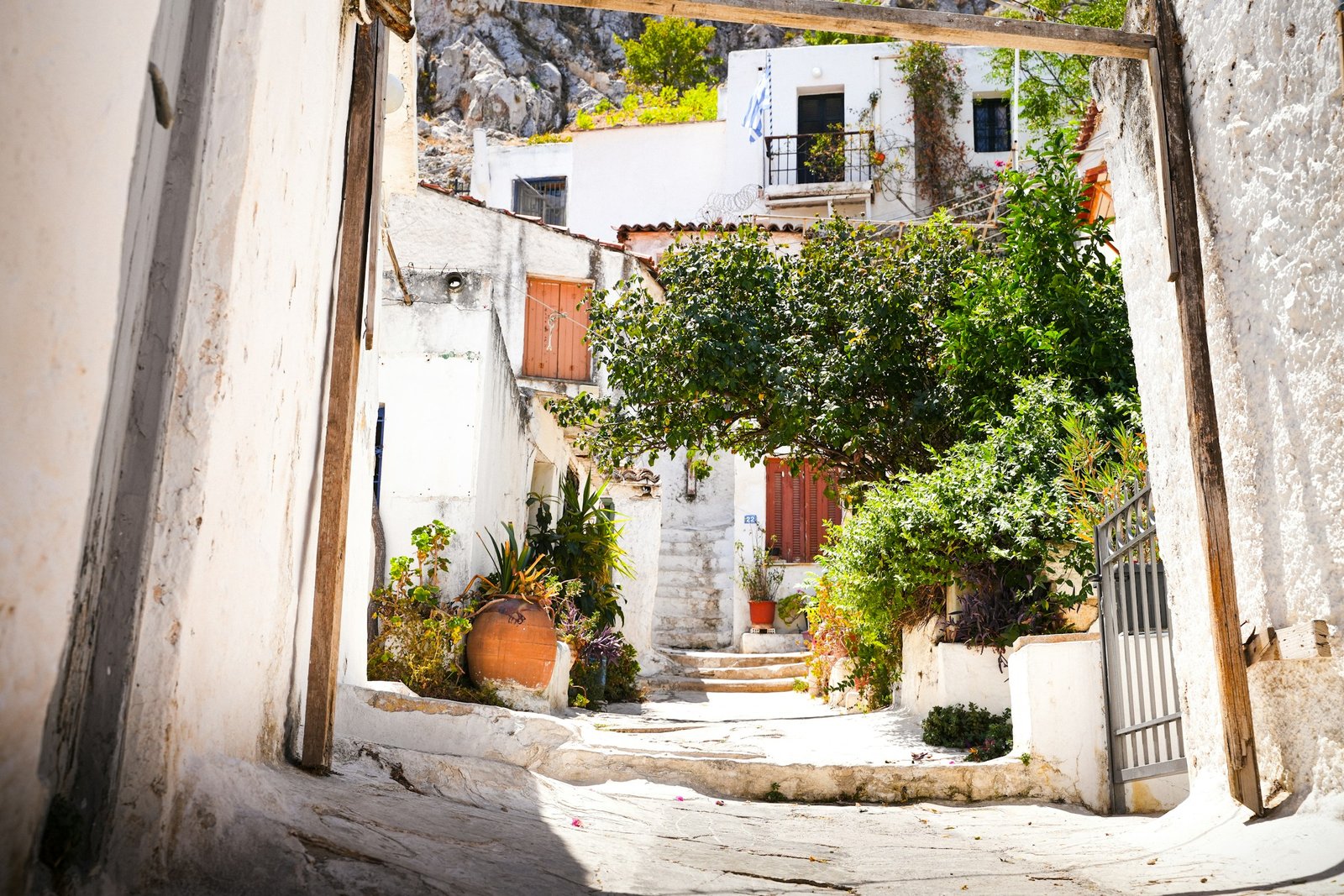
Just below the Acropolis, hidden above the busy streets of Plaka, lies one of the most unusual neighbourhoods in Athens. Anafiotika is a small collection of whitewashed houses, narrow stone passages and steep stairways that looks remarkably different from the rest of the Greek capital. With its brightly painted doors, flowering plants and simple island-style architecture, it feels more like a village in the Cyclades than a neighbourhood in the centre of Athens.
Check availability
What makes Anafiotika particularly appealing is its location. You can explore this peaceful corner of the city before or after visiting the Acropolis without travelling to another part of Athens. There are no entrance tickets, organised visiting hours or major attractions to queue for. Instead, the pleasure comes from walking through the little streets, discovering unexpected views and experiencing a quieter side of Athens only a short distance from its most famous archaeological site.
What Is Anafiotika in Athens?
Anafiotika is a tiny residential neighbourhood on the northeastern slopes of the Acropolis, directly above Plaka. Its distinctive appearance dates back to the 19th century, when craftsmen from the Cycladic island of Anafi settled in Athens. Many had come to the capital to work on construction projects during a period when the city was expanding rapidly. Rather than adopting the architectural style of their new surroundings, they built small homes that reminded them of the island they had left behind.
The result is a neighbourhood that still feels surprisingly separate from the city around it. White walls follow the natural shape of the hillside, narrow steps wind between houses and small terraces are decorated with plants and flowers. In places, the buildings appear almost attached to the enormous rock of the Acropolis rising behind them. Although Anafiotika is only a short walk from some of Athens’ busiest streets, the atmosphere can be remarkably peaceful, particularly in the morning.
Unlike Plaka, which has numerous restaurants, souvenir shops and cafés, Anafiotika remains primarily a place where people live. Its charm comes from that residential character, rather than from commercial attractions. Visitors are welcome to explore the public pathways, but it is important to remember that the colourful doors, courtyards and windows belong to private homes.
Where Is Anafiotika Located?
Anafiotika sits on the northeastern side of the Acropolis hill, between the ancient rock above and the historic Plaka neighbourhood below. On a map, it may appear to be almost part of the Acropolis itself, but the two places are separate. Anafiotika is outside the archaeological site’s ticketed area, and you cannot enter the Acropolis directly from its narrow residential lanes.
This distinction matters when planning your visit. Although the houses are immediately below the Acropolis, reaching an official entrance requires walking around part of the hill. Depending on where you start and which entrance you intend to use, allow approximately 10–20 minutes to walk between Anafiotika and the Acropolis. The route is pleasant, but it includes uneven paving, slopes and some steps.
If you are unfamiliar with the area, it helps to check the Acropolis entrance locations before setting off. The nearest-looking point on a map is not necessarily the entrance you need, and the small streets around Anafiotika can be confusing when you are trying to reach a timed admission slot.
How to Get to Anafiotika
The easiest way to reach Anafiotika is on foot through Plaka. There is no dedicated entrance gate, and the neighbourhood does not have a clearly marked starting point. Instead, several narrow passages and stairways lead uphill from the surrounding streets. Part of the experience is finding your way from the busier streets of Plaka into the much smaller lanes tucked against the Acropolis rock.
One useful approach is via Prytaneiou Street and Stratonos Street, where you can follow the uphill route towards the whitewashed houses. The Church of Agios Georgios tou Vrachou, also known as Saint George of the Rock, is a helpful landmark near the eastern side of Anafiotika. From there, the little passages continue along the hillside, with steps connecting different levels of the neighbourhood.
Another approach is from the upper part of Plaka near Mnisikleous Street. This route involves climbing a series of steps, but it offers a pleasant transition from the traditional streets of Plaka towards the quieter residential area above. You may find that your phone’s navigation is less precise in the narrow passages, so it is worth using nearby streets and churches as landmarks rather than relying on a single map pin.
If you are arriving by public transport, Akropoli and Monastiraki are both useful metro stations. From either station, continue on foot through the historic centre. The most convenient choice depends on whether you intend to explore Plaka, visit the Acropolis Museum or head straight towards the Acropolis. The different approaches are also covered in how to get to the Acropolis in Athens.
Is It Better to Visit Anafiotika Before or After the Acropolis?
Both options work well, although the best choice depends on your Acropolis entrance time and how much walking you want to do. Anafiotika is small enough to fit into an existing sightseeing schedule, so there is usually no need to dedicate a separate morning or afternoon to it.
Visiting Anafiotika Before the Acropolis
Anafiotika can be especially attractive in the early morning, when the streets are quieter and the light falls softly on the whitewashed houses. At this time of day, the neighbourhood often feels more peaceful than it does later, and you may have more space to enjoy the narrow lanes without encountering groups of other visitors.
Starting in Anafiotika also gives you an opportunity to explore part of Plaka before heading towards the archaeological site. You can take a relaxed walk uphill, spend some time among the little houses and then continue around the Acropolis hill towards your chosen entrance. This can be a pleasant way to begin a day in Athens, particularly outside the hottest summer months.
However, if you have booked one of the earliest Acropolis entry times, visiting Anafiotika beforehand may not be the best decision. The Acropolis is often more comfortable earlier in the day, especially during summer, and it would be a shame to lose that advantage by spending too long elsewhere. In that situation, I would recommend visiting the archaeological site first and leaving Anafiotika until afterwards.
You can compare the advantages of different entrance times in the best time of day to visit the Acropolis.
Visiting Anafiotika After the Acropolis
For many visitors, exploring Anafiotika after the Acropolis is the more convenient option. Once you have finished walking around the ancient monuments, you can continue towards the northeastern side of the hill and make your way into the neighbourhood. The change in surroundings is striking: after the exposed archaeological site and its large ancient structures, you suddenly find yourself among tiny houses and narrow residential passages.
This order also works well if you want to continue into Plaka for lunch, coffee or an afternoon stroll. Rather than returning directly to your hotel or heading straight to another major attraction, Anafiotika provides a quieter stop between the Acropolis and the lively streets below.
The main consideration is how tired you feel after visiting the archaeological site. Walking around the